Today, the World Wide Web gained a new standard: ActivityPub. The recommendation has been published by the responsible W3C workgroup after 3 years of work, started in no small part by Christopher Lemmer Webber, founder of the Mediagoblin project. Nextcloud uses ActivityPub, implementing it to handle Activity federation between servers, crucial for our Global Scale architecture.
And indeed, you may already be using ActivityPub now without realizing it.
–Christopher Lemmer Webber
Nextcloud and ActivityPub
Nextcloud implements ActivityPub to inform users about changes to their files, new calendar and so on between users on different Nextcloud servers since Nextcloud 12. This makes ActivityPub part of what makes Nextcloud Global Scale work!
The Activity app which implements ActivityPub will continue to be improved, as its role has expanded over the years to inform users about a lot of things beyond file changes. Its core developer, Joas, blogged earlier about his todo list for the year, including changes to the Activity App.
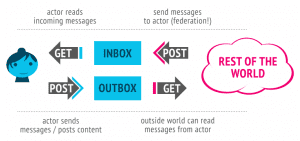
Illustration of how ActivityPub works from W3.org
What is ActivityPub
The origins of ActivityPub trace back to microblogging technology StatusNet, the former Laconia which was first widely implemented at identi.ca. Identi.ca has since migrated to pump.io, the successor to OStatus and the protocol it implements is essentially the base of ActivityPub. Evan Prodromou, the original author of Laconia and pump.io, designed the new protocol to use Activity Streams for commands and transfer data via a simple REST inbox API. The best place to get started to learn more about the protocol is on the W3.org website.
Christopher Lemmer Webber wrote a guest post on the Free Software Foundation blog explaining some history and features of the protocol. It provides a server-server protocol for federation and a client-server protocol for users to connect to a server. The core idea of ActivityPub is to bring together decentralized social networks, gaining critical user mass while keeping data on separate servers.
The popular Twitter alternative Mastodon is a prominent user, same goes for Mediagoblin which aims more at sharing photos and videos. And, then, Nextcloud of course!
Oggi presentiamo Nextcloud Hub 26 Spring, la nostra versione celebrativa. Ti offre una scelta ancora più ampia di strumenti, un'interfaccia più curata, una collaborazione senza stress e la nuova strategia di piattaforma, che permette agli sviluppatori di sfruttare meglio il nostro vasto ecosistema. costruito insieme, progettato per il futuro
Nextcloud Hub 25 Autumn semplifica l'avvio di una potente collaborazione con il pieno controllo dei tuoi dati. Dagli aggiornamenti del design globale al miglioramento dell'usabilità e delle prestazioni, scopri la nostra ultima release in questo blog.
Le organizzazioni, grandi e piccole, necessitano di una soluzione che garantisca la resilienza e la sovranità digitale delle loro operazioni: un'alternativa open source e rispettosa della privacy a Teams. E oggi presentiamo questa soluzione: Nextcloud Talk.
Want to receive notifications about new messages without relying on Google’s servers? We’ll show you how to set up UnifiedPush for Nextcloud Talk in three steps.
Let's take a closer look at Nextcloud Hub's key components and how they come together to create a unified collaboration platform for your organization.
We save some cookies to count visitors and make the site easier to use. This doesn't leave our server and isn't to track you personally!
See our Privacy Policy for more information. Customize
Statistics cookies collect information anonymously and help us understand how our visitors use our website. We use cloud-hosted Matomo
Service:Matomo
Cookies description:
_pk_ses*: Counts the first visit of the user
_pk_id*: Helps not to double count the visits.
mtm_cookie_consent: Remembers that consent for storing and using cookies was given by the user.
Cookies expiry:_pk_ses*: 30 minutes
_pk_id*: 13 months
mtm_cookie_consent: 30 days